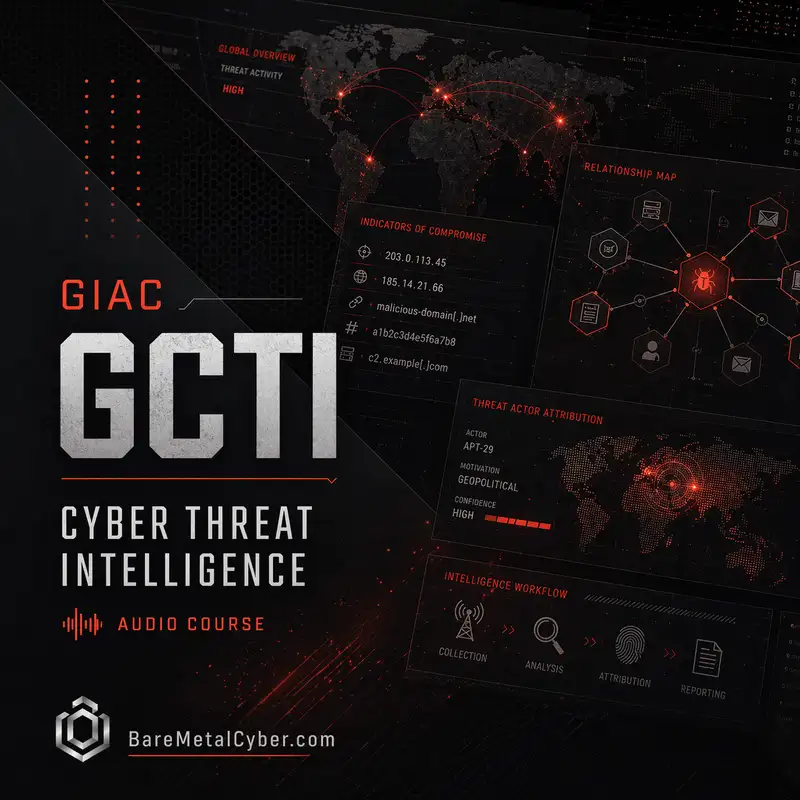
Episode 20 — Exam Acronyms: quick audio reference you’ll reuse
In Episode 20, Exam Acronyms: quick audio reference you’ll reuse, the goal is to turn what often feels like alphabet soup into something familiar and automatic. Acronyms show up everywhere on intelligence and security exams, and they are rarely explained in the moment. The exam assumes fluency, not translation, which means hesitation costs you time and confidence. This episode is designed as a mental warm-up that you can return to whenever those short forms start to blur together. Acronyms are not trivia, they are compression, packing complex ideas into compact signals that professionals use every day. When you hear them and immediately know what they imply, your reasoning speeds up and your answers become more precise. This is about recognition and recall, not memorization in isolation, so each acronym is tied back to how it is actually used in practice.
One of the most common acronyms you will encounter is Indicator of Compromise (I O C). An I O C is a piece of evidence that suggests a system may have been compromised or involved in malicious activity. This evidence can take many forms, such as a suspicious domain, a file hash, or an I P address associated with known malicious behavior. The important idea is that an I O C is a signal, not a conclusion. It tells you where to look and what to validate, not what definitely happened. On an exam, questions often test whether you understand that I O Cs are inputs to detection and investigation rather than definitive proof on their own. In real operations, I O Cs help teams move faster by narrowing the search space. When you hear I O C, think starting point, validation, and context.
Another foundational acronym is Tactics Techniques and Procedures (T T P). This phrase describes how a threat actor operates at different levels of abstraction. Tactics describe the high-level goals, techniques describe the methods used to achieve those goals, and procedures describe the specific implementations seen in the wild. Understanding T T P s helps you reason about behavior rather than individual tools. On exams, this acronym often appears in questions about adversary modeling, detection engineering, and intelligence reporting. The key is recognizing that T T P s are about patterns, not one-off events. When you understand T T P s, you can anticipate what an attacker might do next instead of reacting only to what already happened. This makes T T P s central to both analysis and defense.
Priority Intelligence Requirement (P I R) is another acronym that frequently trips people up because it sounds formal but serves a very practical role. A P I R is a specific question that leadership needs answered to make a decision. It is not a vague request for information and not a general research topic. The distinction matters because intelligence work is judged by whether it supports decisions, not by how much data it collects. On the exam, P I R often appears in scenarios about planning, stakeholder engagement, and intelligence cycles. Recognizing a P I R means recognizing intent and priority. When you see P I R, think decision-driven, scoped, and time-bound, rather than exploratory or open-ended.
F3EAD stands for Find Fix Finish Exploit Analyze and Disseminate, and it represents a tactical operational cycle. This acronym comes from military and intelligence operations and describes a rapid, repeatable process for targeting and action. Find identifies the target, fix confirms location or identity, finish executes action, exploit gathers information from the result, analyze turns that information into insight, and disseminate shares it with those who need it. On exams, F3EAD often appears in questions about operational tempo, targeting, and feedback loops. The important point is that it is a cycle, not a straight line, and that analysis and dissemination are integral parts, not afterthoughts. Understanding F3EAD helps you see how operations and intelligence feed each other continuously.
A common exam moment involves encountering a dense question filled with acronyms and feeling a spike of uncertainty. The difference between panic and confidence is recognition. When acronyms are familiar, your brain focuses on the scenario instead of decoding vocabulary. This is why repeated audio exposure is effective, because it builds automatic recognition. You want to hear an acronym and immediately associate it with its function and implications. On test day, that fluency frees up mental energy for reasoning. In practice, professionals rely on the same fluency to communicate quickly under pressure. Acronyms are a shared shorthand, and the exam is testing whether you speak that language comfortably.
It helps to think of acronyms as a professional shorthand language rather than as obstacles. Shorthand exists to speed communication among people who share context. In intelligence and security, acronyms allow complex ideas to be referenced quickly without repeating long explanations. This efficiency is useful in reports, briefings, and incident response, where time and attention are limited. On an exam, acronyms serve the same purpose, compressing concepts so questions can focus on application rather than definition. When you treat acronyms as part of the language of the field, they stop feeling intimidating. They become cues that trigger whole concepts in your mind. This shift in perspective is often what makes the difference between struggling and flowing through questions.
Open Source Intelligence (O S I N T) is another acronym that appears frequently and carries a specific meaning. O S I N T refers to intelligence gathered from publicly available sources, such as websites, forums, social media, and public reports. The key idea is that O S I N T is open by nature, not that it is casual or low value. On exams, questions often test whether you understand both the strengths and limitations of O S I N T. It can provide broad visibility and context, but it may lack timeliness or verification compared to internal sources. Recognizing O S I N T helps you reason about sourcing, validation, and confidence. When you see O S I N T, think public, accessible, and context-rich, but not inherently authoritative.
C2 refers to Command and Control, which describes how attackers manage and communicate with compromised systems. C2 channels allow attackers to issue instructions, receive data, and maintain control over infected hosts. On exams, C2 often appears in questions about network traffic analysis, detection strategies, and kill chain stages. Understanding C2 means recognizing that attackers need communication pathways, even when they try to be stealthy. This makes C2 traffic a valuable detection opportunity. When you hear C2, think coordination, persistence, and external communication rather than initial compromise. This mental association helps you quickly place the concept in the attack lifecycle.
Structured Threat Information Expression (S T I X) is a standard language for describing cyber threat information in a structured, machine-readable way. S T I X allows indicators, relationships, and context to be represented consistently across tools and organizations. On the exam, S T I X often appears in questions about information sharing and automation. The key idea is structure, because structure enables correlation and reuse. S T I X is not about analysis itself, it is about representation. When you see S T I X, think standardized description of threat data that supports scale and consistency. This helps distinguish it from transport mechanisms or analytical frameworks.
Trusted Automated Exchange of Intelligence Information (T A X I I) complements S T I X by defining how that structured data is transported. T A X I I specifies protocols for sharing threat information between systems in a controlled and automated way. On exams, T A X I I is often paired with S T I X, and understanding the distinction matters. S T I X describes the data, while T A X I I moves the data. Keeping that separation clear helps you avoid common exam traps. When you hear T A X I I, think delivery mechanism rather than content. This clarity allows you to answer questions about integration and sharing accurately.
Advanced Persistent Threat (A P T) is an acronym that describes a category of adversary rather than a specific technique. An A P T is typically characterized by sustained operations, significant resources, and strategic objectives. On exams, A P T often appears in contrast with opportunistic attackers or cybercriminals. Understanding A P T means recognizing patience, persistence, and targeting. It does not automatically mean invincible or flawless, but it does imply intent and capability beyond casual attacks. When you see A P T, think long-term campaigns and strategic goals rather than smash-and-grab activity. This framing helps you choose appropriate responses in scenario questions.
Common Vulnerabilities and Exposures (C V E) is the standardized system for identifying publicly disclosed software vulnerabilities. A C V E identifier provides a common reference that allows vendors, defenders, and researchers to talk about the same vulnerability without confusion. On exams, C V E often appears in questions about vulnerability management, patching, and risk prioritization. The key idea is standardization and shared reference. A C V E does not imply exploitability by itself, it simply identifies the issue. When you see C V E, think catalog and reference, not automatic risk. This distinction helps you reason about vulnerability context rather than reacting reflexively.
Taken together, these acronyms form a core vocabulary that the exam expects you to understand instantly. They represent concepts that span intelligence collection, analysis, operations, and sharing. Fluency with them allows you to focus on applying knowledge rather than decoding language. Repetition through audio is effective because it builds recognition without visual dependency. Over time, these terms start to feel natural, like professional shorthand you use without effort. That comfort translates directly into exam performance and real-world confidence.
Acronyms are shortcuts, not obstacles, when you know what they stand for and what they imply. The real value comes from being able to hear an acronym and immediately connect it to purpose, context, and use. A useful way to reinforce this is to practice articulating definitions out loud in your own words, because that builds both recall and understanding. When you can explain these terms smoothly, you are less likely to hesitate under pressure. This episode is meant to be one you return to as a refresher whenever you need to reset that fluency. When acronyms stop slowing you down, they start working for you.